Rabu, 18 Desember 2019

Google settles 'longstanding' tax dispute with Australia - Reuters

FILE PHOTO: The logo of Google is seen at the high profile startups and high tech leaders gathering, Viva Tech,in Paris, France May 16, 2019. REUTERS/Charles Platiau

SYDNEY (Reuters) - Alphabet Inc’s Google has settled a “longstanding” tax dispute with Australia’s tax office, it said on Wednesday, after paying an extra A$481.5 million ($326.75 million) on top of its previous tax bill.

The settlement comes after an audit that looked into the tech giant’s tax practices between 2008 and 2018, a Google spokeswoman said.

In a separate statement, the Australian Taxation Office (ATO) said it has now netted A$1.25 billion after also settling tax disputes recently with other tech giants such as Microsoft, Apple and Facebook under the Multinational Anti-Avoidance Law (MAAL).

“Thanks to the efforts of our ATO officers under the Tax Avoidance Taskforce and the introduction of the MAAL, Australian sourced sales by these digital giants will now be returned to Australia’s tax base,” the ATO said in a statement, calling the settlement “another e-commerce victory.”

Facebook, Google, Amazon and other large technology companies have faced criticism globally for reducing their tax bills by booking profits in low-tax countries regardless of the location of the end customer. Such practices are frowned upon by many countries as unfair.

A Google spokeswoman said the settlement with the ATO will provide certainty for future tax treatment.

Australian Treasurer Josh Frydenberg said in a statement the establishment of the tax avoidance taskforce in 2016 has helped strengthen tax compliance of multinationals and large corporations.

“Ensuring large companies and multinationals pay the right amount of tax means we can continue to deliver the essential services Australians rely on,” Frydenberg said.

Reporting by Swati Pandey; Editing by Shri Navaratnam

Let's block ads! (Why?)


https://news.google.com/__i/rss/rd/articles/CBMifmh0dHBzOi8vd3d3LnJldXRlcnMuY29tL2FydGljbGUvdXMtYXVzdHJhbGlhLXRheC1hbHBoYWJldC9nb29nbGUtc2V0dGxlcy1sb25nc3RhbmRpbmctdGF4LWRpc3B1dGUtd2l0aC1hdXN0cmFsaWEtaWRVU0tCTjFZTTBPN9IBNGh0dHBzOi8vbW9iaWxlLnJldXRlcnMuY29tL2FydGljbGUvYW1wL2lkVVNLQk4xWU0wTzc?oc=5

2019-12-18 07:14:00Z
52780507093746

Australia heatwave: Nation endures hottest day on record - BBC News

Australia has experienced its hottest day on record with the national average temperature reaching a high of 40.9C (105.6F).

The Bureau of Meteorology (Bom) said "extensive" heat on Tuesday exceeded the previous record of 40.3C set on 7 January 2013.

Taking the average of maximum temperatures across the country is the most accurate measure of a heatwave.

The record comes as the nation battles a severe drought and bushfire crisis.

Forecasters had predicted the most intense heat would come later in the week, meaning the record could be broken again.

As hundreds of fires rage, Prime Minister Scott Morrison has been criticised for his response to the natural disasters and his government's climate policies.

Why has this happened now?

Australia heated up this week as a mass of hot air swept east across the continent, with meteorologists forecasting "severe to extreme heatwave conditions".

Several individual heat records for towns and cities have already been shattered. On Tuesday, places across the nation's centre recorded temperatures above 45C.

At the start of the week, Perth, the capital of Western Australia, recorded three days in a row above 40C - a record for December.

The dominant climate driver behind the heat has been a positive Indian Ocean Dipole (IOD) - an event where sea surface temperatures are warmer in the western half of the ocean, cooler in the east.

The difference between the two temperatures is currently the strongest in 60 years. The warmer waters cause higher-than-average rains in the western Indian Ocean region, leading to flooding, and drier conditions across South East Asia and Australia.

But Australia has been enduring a drought for a long time - several years in some places. Bom says the dry soil has meant less evaporation - which would normally exert a cooling influence on the landscape.

What is climate change doing to Australia?

According to Bom, Australia has warmed overall by just over 1C since 1910, with most of the heating occurring since 1950.

Nine of Australia's top 10 hottest years on record have all occurred since 2005.

Officials predict that 2019, on the temperatures recorded so far, will be among the four warmest years on record. Bom says it's expecting national mean temperatures to be at least 1.3C above the long-term average of 27.5C.

That heat has helped create the conditions for natural disasters like bushfires, droughts and floods - which have always happened in Australia - to be more frequent and more severe.

"Australia's climate is increasingly influenced by global warning and natural variability takes place on top of this background trend," says Bom.

Vast areas of the nation are struggling through a second and third year of drought. According to the measurements for 2019 so far, the year has been Australia's driest in over a century.

Media playback is unsupported on your device

Australia's conservative government has been criticised both at home and internationally for what's seen as an inadequate climate record.

The country is one of the highest emitters of carbon pollution per capita, largely because it is still heavily reliant on coal-fired power. The UN has also said it is among the minority of G20 nations falling short on its emissions promises.

The government has been reluctant to talk about the role of climate change in exacerbating bushfires, a stance which has sparked protests.

Critics have accused Mr Morrison of being "missing in action" on the issue. That pressure escalated this week after it emerged he was overseas on holiday.

After local media reported he was in Hawaii, phrases such as #WhereTheBloodyHellAreYou, #WhereisScoMo and #FireMorrison trended on Twitter.

How damaging can heatwaves be in Australia?

Heatwaves are Australia's deadliest natural disaster and have killed thousands more people than bushfires or floods.

Last summer (2018-2019) was recorded as the nation's hottest on record, as average temperatures soared past 30C (86F) for the first time.

At least five of the days were recorded among the nation's top 10 hottest on record.

The heat, which was concentrated over one fortnight in January, caused mass wildlife deaths, sparked bushfires and led to a rise in hospital admissions.

It also sparked furious political discussion about the nation's energy grid, after densely populated city areas were forced to endure blackouts amid the heat.

What does this mean for the fires?

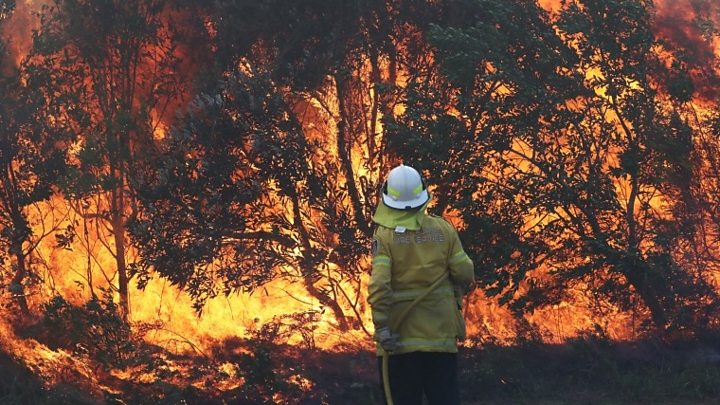
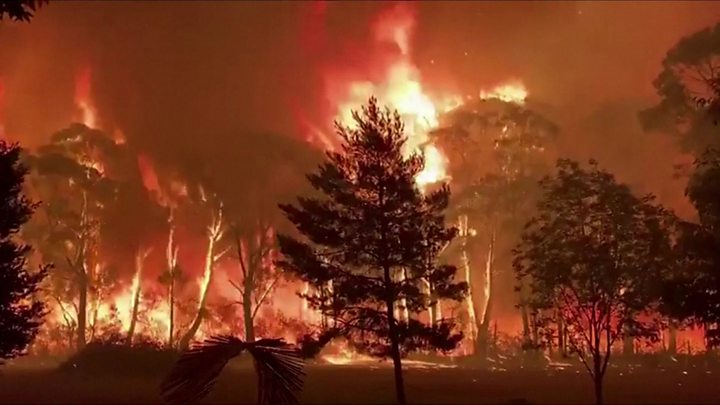
More than 100 blazes are still burning across Australia's east coast - with the high temperatures escalating dangerous conditions.

Bom and fire authorities have warned that the record temperatures have made the fires more volatile and harder to fight.

Let's block ads! (Why?)


https://news.google.com/__i/rss/rd/articles/CBMiMWh0dHBzOi8vd3d3LmJiYy5jb20vbmV3cy93b3JsZC1hdXN0cmFsaWEtNTA4MTc5NjPSATVodHRwczovL3d3dy5iYmMuY29tL25ld3MvYW1wL3dvcmxkLWF1c3RyYWxpYS01MDgxNzk2Mw?oc=5

2019-12-18 03:12:37Z
52780507823880

Selasa, 17 Desember 2019

NASA satellite image shows grim Australian fire devastation from space - CNET

aussiefires

This Suomi NPP satellite image shows the massive amounts of smoke from actively burning fires, designated by the red spots.

NASA Worldview, Earth Observing System Data and Information System (EOSDIS)

New South Wales in Australia is under stress from a heatwave and ongoing bush fires that are eating up the landscape. The ground is choked with smoke that has reached into Sydney while the view from space reveals the extent of the damage.

The National Oceanic and Atmospheric Administration and NASA operate the Suomi NPP satellite. NASA released the satellite's look at New South Wales from Monday. It shows a massive blanket of smoke emanating from active fires marked by bright red spots. 

"To date the size of the area burned is 1.5 times the size of the state of Connecticut (approximately 5.3 million acres of land)," NASA said. The New South Wales Rural Fire Service had logged 115 active fires as of Monday, with 59 of them still needing to be contained.

The fire threat looks like it may not let up for some time. "It has already been a challenging fire season and this is expected to continue," the Bushfire and Natural Hazard Cooperative Research Centre tweeted on Sunday while warning of increased danger as the fire season progresses.

NASA's eyes in the sky will continue to monitor the fire situation in Australia. It's already bad, but it's likely to get worse.

Now playing: Watch this: How to stop climate catastrophe | What the Future

6:23

Originally published Dec. 16, 4:33 p.m. PT

Let's block ads! (Why?)


https://news.google.com/__i/rss/rd/articles/CBMiYWh0dHBzOi8vd3d3LmNuZXQuY29tL25ld3MvbmFzYS1zYXRlbGxpdGUtaW1hZ2Utc2hvd3MtZ3JpbS1hdXN0cmFsaWFuLWZpcmUtZGV2YXN0YXRpb24tZnJvbS1zcGFjZS_SAWxodHRwczovL3d3dy5jbmV0LmNvbS9nb29nbGUtYW1wL25ld3MvbmFzYS1zYXRlbGxpdGUtaW1hZ2Utc2hvd3MtZ3JpbS1hdXN0cmFsaWFuLWZpcmUtZGV2YXN0YXRpb24tZnJvbS1zcGFjZS8?oc=5

2019-12-17 00:33:00Z
CAIiEEd5ixMrJHzRbJ9nVfyeztgqEwgEKgwIACoFCAow4GowoAgwkRo

Senin, 16 Desember 2019

Australia bushfire: Boy, 12, drives pickup to flee with dog - BBC News

Police have rescued a 12-year-old boy who fled a raging bushfire in Western Australia by driving his brother's pickup to safety with their dog.

Luke Sturrock was alone at home when a fast-moving blaze threatened the town of Mogumber, north of Perth, on Sunday.

His dad, Ivan Sturrock, and older brother were out fighting the fire as it ripped through the area.

They told him to flee to an orange tree about 4km (2.4 miles) away if the fire got too close to their home.

When the fire closed in, the boy grabbed his dog and escaped in his brother's Ford Ranger.

About an hour later, firefighters who were battling the blaze nearby came across the boy behind the wheel of the vehicle and pulled him over.

"Typical farm boy, he was pretty clever, I think the problem was he just didn't quite know where to go and it was hard to see with all the smoke," Craig Spencer, of the Bindoon Bushfire Brigade, told ABC Radio Perth.

"So I think he probably panicked a bit and when we found him he was pulled up on the side of the road."

The fire crew took him to safety and left him with police, who reunited him with his father.

Mr Sturrock said he was proud of his son.

"We taught him to drive since he was about seven just in case things like this do happen and I was quite proud of him; he did exactly what we told him to do," Mr Sturrock told ABC News.

Dalwallinu police officer Michael Daley, who reunited the boy with his father, urged families to "have a plan and know it" if a bushfire threatened their home.

Emergency warnings for dangerous bushfires have been issued in eastern and western Australia.

In the state of Western Australia, firefighters have been battling a bushfire north of Perth for six days.

Media playback is unsupported on your device

The blaze, which has engulfed more than 13,000 hectares of land, was downgraded on Monday, with evacuated residents expected to return home.

Meanwhile, authorities issued fresh warnings about a "mega blaze" after it spread beyond containment lines and razed 20 houses near Sydney.

How bad are the bushfires in Australia?

Since September, six people have died in a bushfire crisis that has engulfed Australia, particularly the eastern states of New South Wales (NSW) and Queensland.

The blazes have destroyed more than 700 homes and blanketed towns and cities in smoke.

The bushfires and extreme weather have ravaged Australia's landscape, sparking public debate about the need for stronger climate action.

Last week, parts of Sydney suffered air quality 22 times worse than the clean air standard.

A heatwave sweeping east across the country is also expected to increase the fire risk this coming week.

Across the nation, temperatures are set to exceed 40C in many areas. Parts of Sydney could reach 46C by the end of the week, meteorologists say.

Let's block ads! (Why?)


https://news.google.com/__i/rss/rd/articles/CBMiMWh0dHBzOi8vd3d3LmJiYy5jb20vbmV3cy93b3JsZC1hdXN0cmFsaWEtNTA4MDYxOTnSATVodHRwczovL3d3dy5iYmMuY29tL25ld3MvYW1wL3dvcmxkLWF1c3RyYWxpYS01MDgwNjE5OQ?oc=5

2019-12-16 13:56:04Z
CBMiMWh0dHBzOi8vd3d3LmJiYy5jb20vbmV3cy93b3JsZC1hdXN0cmFsaWEtNTA4MDYxOTnSATVodHRwczovL3d3dy5iYmMuY29tL25ld3MvYW1wL3dvcmxkLWF1c3RyYWxpYS01MDgwNjE5OQ

Australians Love Rooftop Panels. That’s a Problem for Big Solar - Yahoo Finance

(Bloomberg) -- With its sunny skies and plenty of available land, it’s not hard to see why large-scale solar projects were drawn to Australia.

Yet a rush of household installations has started to play havoc with the economics of those sprawling facilities. Combine that with the struggle shared by grids around the world as they move from round-the-clock power generation to more volatile renewable sources, and the outlook for large-scale solar in Australia looks less rosy.

About one in every four homes in the nation of almost 25 million now has solar panels and that number continues to rise, increasing power supply and lowering consumption from the grid during the middle of the day, when the sun is at its strongest. It has even forced some utility-scale solar plants to shut down during their peak production times or risk having to pay the grid to take the electricity they produce.

“Rooftop solar is an ever-growing risk for its large-scale counterpart,” said Lara Panjkov, an analyst at BloombergNEF in Sydney. “When rooftop solar operates, it reduces grid demand and suppresses wholesale electricity prices.”

BloombergNEF projects a sharp fall in income for large-scale solar in the next two to three years. The average price that plants receive in Victoria state, a market which includes the nation’s second-biggest city Melbourne, could drop as low as A$41 per megawatt-hour in 2022, from around A$140 so far this year.

The government’s subsidy regime also puts big solar developers at a disadvantage, according to Kim Nguyen, head of Australia operations at renewables investor Foresight Group. Incentives for off-grid solar can still cover 30% to 40% of their total cost, although they are being progressively scaled back. Support from the government’s large-scale generation certificates typically amounts to less than 5% of a project’s capital cost, Nguyen said.

Innogy SE, which is building the country’s biggest solar farm to date, is looking at potential solar investments “with more conservative assumptions than a year or two ago,” said Matthew Dickie, the regulations manager at the major German utility’s Australian unit.

One area where he’s looking for change is in the calculation of transmission losses. Under the current system, marginal loss factors -- a measure of how much electricity is lost over power lines -- are assessed by the market operator and have hit solar plants in remote locations particularly hard. Several industry players, including Innogy, are pushing for those losses to be calculated on an average basis across the entire network.

“Despite the room for policy improvement, Australia does have a lot of constants which make it still worthy of investigation, such as great solar and wind resource, a relatively low population density, a strong economy and robust rule of law,” Dickie said.

The growing headwinds faced by big solar have contributed to a drop off in renewables investment growth this year. Investment in new large-scale solar in Australia has trailed off this year but still totals about $7.9 billion since 2015, BloombergNEF data show. Approximately $8.3 billion was spent on rooftop solar in Australia in the period, according to BNEF estimates.

“For so many reasons, the boom in utility-scale solar has gone,” said Stephen Panizza, head of renewables at Sydney-based Federation Asset Management.

It won’t make sense to invest in large-scale solar until it becomes economical to add as much as 6 hours of battery storage, the level at which solar would be able to continue supplying the grid well into the peak evening demand period, Panizza said. That’s still a few years away and, in the meantime, there is more growth potential in wind power in Australia, he said.

Foresight’s Nguyen is not as pessimistic. She remains open to investing in big solar projects, pointing out that it still has advantages over rooftop. Large-scale facilities are more reliable -- they are maintained with much more rigor and attention than your average rooftop panel -- and more flexible, being able to switch on and off rapidly in response to price signals. It’s also more economical to add battery storage to a large solar plant than to each individual household.

There’s little doubt that Australia needs to add substantial renewable generation capacity in the years ahead as aging coal fired plants retire -- the market operator’s latest long-term plan said that more than 30 gigawatts of large-scale clean energy projects would be needed by 2040. Still, with more than 2 gigawatts of solar projects commissioned over the next three years, there are concerns in the industry that some will face significant financial stress.

Marginal loss factors, grid issues and network penalties “are already hurting utility-scale solar owners’ revenue models,” said Panjkov. “Most of these issues are likely to get worse before they get better.”

To contact the reporter on this story: James Thornhill in Sydney at jthornhill3@bloomberg.net

To contact the editors responsible for this story: Ramsey Al-Rikabi at ralrikabi@bloomberg.net, Rob Verdonck

For more articles like this, please visit us at bloomberg.com

©2019 Bloomberg L.P.

Let's block ads! (Why?)


https://news.google.com/__i/rss/rd/articles/CBMiVWh0dHBzOi8vZmluYW5jZS55YWhvby5jb20vbmV3cy9hdXN0cmFsaWFucy1sb3ZlLXJvb2Z0b3AtcGFuZWxzLXByb2JsZW0tMTkwMDAwNzA5Lmh0bWzSAV1odHRwczovL2ZpbmFuY2UueWFob28uY29tL2FtcGh0bWwvbmV3cy9hdXN0cmFsaWFucy1sb3ZlLXJvb2Z0b3AtcGFuZWxzLXByb2JsZW0tMTkwMDAwNzA5Lmh0bWw?oc=5

2019-12-16 11:00:00Z
CBMiVWh0dHBzOi8vZmluYW5jZS55YWhvby5jb20vbmV3cy9hdXN0cmFsaWFucy1sb3ZlLXJvb2Z0b3AtcGFuZWxzLXByb2JsZW0tMTkwMDAwNzA5Lmh0bWzSAV1odHRwczovL2ZpbmFuY2UueWFob28uY29tL2FtcGh0bWwvbmV3cy9hdXN0cmFsaWFucy1sb3ZlLXJvb2Z0b3AtcGFuZWxzLXByb2JsZW0tMTkwMDAwNzA5Lmh0bWw

Australia's state governments get tough on climate protesters - Al Jazeera English

Climate activist Greg Rolles does not enjoy breaking the law, but he feels like there is no other option.

"Sometimes you've got to put the common good of all people ahead of your own needs and interests," Rolles told Al Jazeera. "I don't want to be bullied by the media or deal with police, but I also don’t want to leave the next generation with the burden of a burning home."

Rolles, 37, is a member of Christian Climate Action Australia.

In November last year, he spent several hours suspended in a bamboo tripod he had erected over a railway line used to transport coal to the Abbot Point terminal, about 200 kilometres (124 miles) south of Townsville in far north Queensland. Abbot Point is owned by Adani, an Indian mining company, which is the focus of significant protest as it prepares to open a new coal mine that could affect the Great Barrier Reef.

Arrested and charged with three counts including trespassing, Rolles argued in court that his actions were permissible under the ‘extraordinary emergency’ defence, which says individuals are not criminally liable if they are acting in response to a sudden emergency. An oft-cited example would be shipwrecked sailors forced to eat the weakest crew member in order to survive.

The magistrate did not agree that the situation was an emergency. Rolles was found guilty, fined 7,000 Australian dollars ($4,810), and ordered to pay 2,233.40 Australian dollars ($1,535) to Aurizon, the country’s rail freight operator. Aurizon is now suing Rolles for 75,000 Australian dollars ($51,562) in damages.

But as climate protests become widespread, it is not just fines with which activists are being threatened. 

Australia protests

The authorities in some Australian states are taking a tougher line on protest because they say the tactics of groups such as Extinction Rebellion (XR) put people at risk [File: Tony McDonough/EPA]

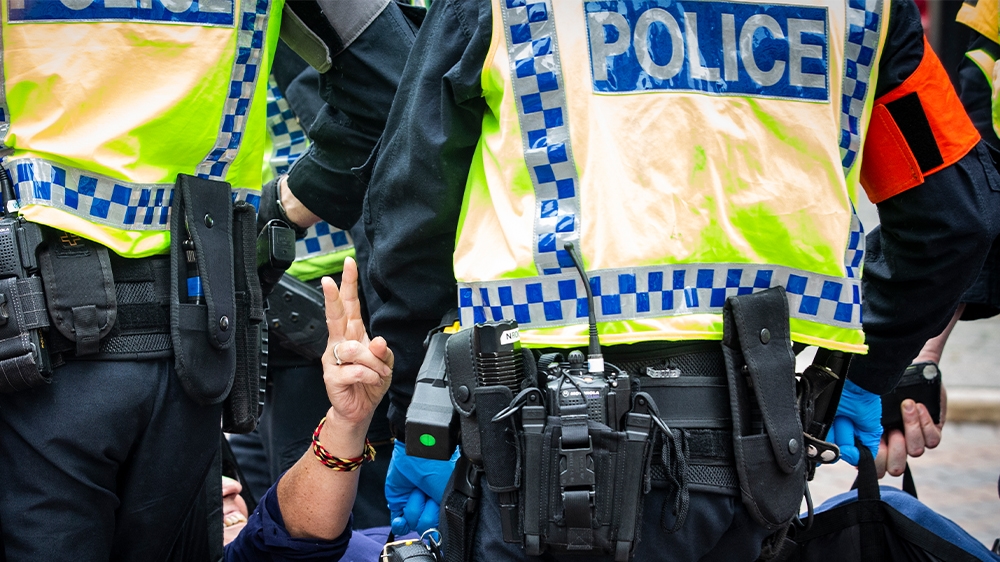
Under new laws recently enacted in Queensland, people using so-called ‘dangerous devices’ – such as the lock-on devices that activists use to attach themselves to each other or to immovable objects such as fences and rail tracks – risk prison.

The law was developed after a series of disruptive Extinction Rebellion actions in Brisbane in mid-2019, in which more than 70 people were arrested and charged by police.

Increasing risks

Queensland Premier Annastacia Palaszczuk argued the legislation was necessary because police and bystanders were at risk.

"Inside these cylinders and drums are glass fragments – even butane gas containers – so that anyone trying to cut a protester free will be injured or worse," Palaszczuk told Queensland Parliament in August.

There is no evidence that the protesters in Queensland have used devices with glass or gas. Under the law, police also have the power to search anyone they reasonably suspect is in possession of a lock-on device. People found using such devices could face up to two years in jail.

The magistrate in Rolles’ case said that Rolles could have used other methods to make his views heard, such as speaking to his local member of parliament or taking part in a lawful protest. Rolles said these suggestions were inadequate.

"This is a climate emergency, a major crisis our political leaders are ignoring," he told Al Jazeera. "We only have one planet home and it’s burning… If we don’t use non-violent protest, we won’t get in the way. History shows this."

Matt McDonald, an associate professor at the University of Queensland and an expert in climate politics, agrees that protests are key to changing government policy on issues such as climate change.

"We tend to see action from governments even in the face of their ideological tendencies when they sense that public opinion is going in the other direction," McDonald told Al Jazeera.

"For example, in the 2007 election, [then-Prime Minister] John Howard promised carbon pricing… The scale of public opinion in polls and protests can end up putting a lot of pressure on a government."

McDonald said that the Queensland Labor government’s new legislation was more about sending a signal to its more conservative voters rather than actually stopping protests.

"Using the idea of disruption or concern for health or well-being is thoroughly disingenuous," he explained. "It’s a strategy that helps them stay in power in the next election; they need to be seen as not being aligned to groups like Extinction Rebellion."

'Draconian' law

In Tasmania, Australia’s southernmost state, even stricter anti-protest laws may soon be enacted.

Australia climate protests

Activists from the Extinction Rebellion (XR) have been holding protests across Australia this year [File: Tony McDonough/EPA]

The Workplace (Protections from Protesters) Amendment Bill would amend existing legislation found unconstitutional by the Australian High Court in 2017 because it restricted free speech. The amendment recently passed Tasmania’s lower house of parliament and will be discussed in the upper house when it sits again in 2020.

Leader of the Tasmanian Greens, Cassy O’Connor, described the proposed amendment to Al Jazeera as ‘draconian’.

"The law makes everywhere in Tasmania a potential workplace where people protesting face arrest. It removes police ‘move on’ powers, where police should ask protectors to move on [prior to arrest]," she said. "A person obstructing a business or taking part in a protest in a public place means that police can arrest them immediately under the act."

Dispatches from the front lines of environmental reporting

Individuals found guilty of breaking this law could face jail terms of 18 months for a first offence, and four years for a second offence. Threatening to protest a business on social media would also become a criminal act under the amendment.

"This is draconian in that it provides an incredibly broad definition of business activity," O’Connor said. "Critically, it is designed to have a chilling effect on dissent on an island that has a long and proud history of public protest."

The Tasmanian Chamber of Commerce and Industry (TCCI) said they welcomed the proposed legislation because it would protect businesses and workers.

"The TCCI supports absolutely the right of people to protest lawfully, but not to conduct economic terrorism," CEO Mark Bailey said in a statement provided to Al Jazeera.

However, many are doubtful that tough laws will stop climate change activists.

"If you’re chaining yourself to a fence or a bulldozer, these people aren’t thinking selfishly about these results, they’re already really mobilised," McDonald said. "For every person who might be dissuaded, there will be someone else who will want to do it."

Nicole Rogers from the School of Law and Justice at Southern Cross University believes that the definition of what constitutes ‘lawful’ behaviour may even begin to change as climate protests become more widespread.

'No safe place'

"Standards of behaviour aren’t stable, especially when change is inevitable," she told Al Jazeera. "With climate change, there’s no safe place, there’s nothing we can take for granted anymore. So the concept of disruption and shifting standards really comes to light in this situation."

"A process of ongoing adjustments in the face of galloping catastrophic change lies ahead of us," Rogers explained. "With the advantage of hindsight, we’re going to be judged very harshly – what seems reasonable now will come to seem unreasonable for future generations."

Australia's Mine Games

Activist Rolles says the threat of jail is not enough to stop him and others from pushing for climate action. As a Christian, he believes it is his moral, civil, and spiritual duty to act, and since November last year, he has been arrested on two additional occasions.

"It’s either stand up now and do civil disobedience, or face a future of a living hell," Rolles said. "I don’t want to face punishment, I don’t want to face jail or fines, but I’m more scared for the next generation."

"We have so many freedoms in Australia because our ancestors fought for them," he added. "If we don’t fight hard and give everything we’ve got, we will lose all these privileges in the climate crisis."

O’Connor of the Tasmanian Greens agrees.

"All across Australia, hundreds of thousands are taking to the streets to protect the climate," she said. "Instead of looking at its own policies on the environment, the government’s response is designed to make the problem go away by locking it up.

"People don’t want to go to jail, but you cannot jail your way out of the climate crisis."

Let's block ads! (Why?)


https://news.google.com/__i/rss/rd/articles/CBMicGh0dHBzOi8vd3d3LmFsamF6ZWVyYS5jb20vbmV3cy8yMDE5LzEyL2F1c3RyYWxpYS1zdGF0ZS1nb3Zlcm5tZW50cy10b3VnaC1jbGltYXRlLXByb3Rlc3RlcnMtMTkxMjE2MDQwODE0NjA3Lmh0bWzSAXRodHRwczovL3d3dy5hbGphemVlcmEuY29tL2FtcC9uZXdzLzIwMTkvMTIvYXVzdHJhbGlhLXN0YXRlLWdvdmVybm1lbnRzLXRvdWdoLWNsaW1hdGUtcHJvdGVzdGVycy0xOTEyMTYwNDA4MTQ2MDcuaHRtbA?oc=5

2019-12-16 06:43:00Z
CAIiECSHj8qQmhByEzAbycONb-YqFAgEKgwIACoFCAowhgIwkDgw0O8B

Sabtu, 14 Desember 2019

Farewell, Tiger! Australia prepares to say goodbye to the U.S. playing captain for good - Golf.com

MELBOURNE, Australia — It’s time to address the Big Cat in the room. These words are difficult to write, especially for an Australian writer. But here goes…

The Sunday singles finale to the Presidents Cup is likely to be the last time Tiger Woods plays tournament golf in Australia.

Woods, the U.S. Team’s playing captain, will cap arguably the greatest edition in the 25-year history of this biennial contest with a match against International rookie Abraham Ancer. There is a good chance it will be the last time the golf world gets to see Woods, the artist, use Alister MacKenzie’s famed Royal Melbourne as his canvas. At least under the pressure of a tournament.


Why? For one thing, Woods missed out on automatic qualification for this year’s Cup. He was fortunate to have a self-pick up his sleeve and, thankfully, the choice was easy when he won a record-equalling 82nd PGA Tour title in Japan in late October. Gosh, we’re lucky he did — but there’s no guarantee he’ll do the same in the future.

The American team keeps getting replenished with studs like Patrick Cantlay and Xander Schauffele, rookies this week. In years to come, young guns like Matt Wolff and Collin Morikawa will fill out the team.

Secondly, the Presidents Cup won’t return to Australia until at least 2027, when Woods will be 51. The 2021 Cup is at Quail Hollow and TPC Harding Park in 2025 are the only confirmed venues. The 2023 edition is likely to be held in Asia.

It has been eight years since Woods played Down Under — when he was here for the 2011 Cup and Australian Open. It is getting harder and harder for Woods to make special trips to Australia with a PGA Tour schedule that encompasses nearly the entire calendar year. Finally, the Australian Open’s spot on the schedule — it’s usually held during the week of Thanksgiving in the U.S. — runs up against Woods’ Hero World Challenge held in the Bahamas in early December.

It’s heartbreaking to consider the possibility that Sunday at Royal Melbourne is Woods’ competitive swan song in Australia. The fans down here have relished every minute of the six trips he’s made. And hasn’t he been glorious to watch this week?

Consider that beautifully-flighted, sawed-off short iron draw he threw into the 18th hole in Friday’s foursomes match. It left his club like a laser but landed like a butterfly with sore feet, setting Justin Thomas up for a birdie to win their match. The pair’s subsequent celebration will go down in Presidents Cup folklore.

Remember at the par-3 5th during Thursday’s four-ball, when the 15-time major winner hit a bump-and-run from a nasty lie between two greenside bunkers that dropped obediently into the hole for birdie? It was so exquisite that teammate Thomas had no issues with Woods channeling Jordan Spieth and telling his partner, “Go get that!”

Those are just the two most recent additions to a long highlight reel of Woods on the Melbourne Sandbelt.

His obsession with the revered Aussie golf region began in 1997. The Californian made his first trip to Melbourne’s Sandbelt — his second to Australia after the 1996 Aus Open — to contest the Australian Masters at Huntingdale Golf Club. He tied for a respectable eighth.

That was in February, two months before he’d secure a historic win at another Masters. You know, the one at Augusta National.

Thousands of fans lined the fairways of Huntingdale to get a glimpse of the chosen one who they’d read about in magazines and newspapers — well before social media, of course.

They’d heard of his fearsome power, but Woods only hit one driver in the opening round. As a local reporter detailed at the time, “A graphic impression of the slightly built young man’s power was provided with almost every shot. At the par-5 14th, at 554 metres (605 yards) one of the longest in Australian tournament golf, Woods humbled the hole with a 3-wood and 2-iron.”

The fan stampede synonymous with Tigermania was in its infancy in 1997, but already annoying fellow pro golfers. In the same Aussie Masters, local pro Brett Ogle, himself a two-time PGA Tour winner, snapped to fans chasing Woods: “Tiger’s not the only one playing out here.”

Maybe not. But Woods is perhaps the only golfer who captures the imagination of Australians who don’t even play golf.

Woods’ next trip to the Sandbelt came in 1998, when in his Presidents Cup debut he demanded captain Jack Nicklaus send him out on Sunday face local star Greg Norman in the singles at Royal Melbourne. Woods beat the Shark on the 18th hole, but the International team secured their only Cup victory to date.

The pinnacle of Woods’ Sandbelt history came in 2009 when he picked apart the world-renowned Kingston Heath en route to a meaningful Australian Masters victory. Although his first appearance in Australia in 11 years cost the Victorian state government a reported $3 million, Woods justified the spend by wowing fans with beautifully-crafted golf shots while leading from start to finish. He added the now-defunct tournament’s gold jacket to the green jackets already in his wardrobe.

Ten years later, Aussie fans have jumped at the chance to see the reigning Masters champion tackle Royal Melbourne while in vintage form.

Among those in the crowd was Alex Gough, a New York-based Australian who made the 10,000-mile journey home from his Brooklyn residence just to see Woods. Gough, 32, has been a member of Royal Melbourne since 2008 and was on hand to witness Woods at the 2011 Cup.

But this time is different, says Gough.

“I was there in 2011 … it was cool, but Tiger hadn’t won in two years. This Presidents Cup has so much more pop in it with him playing so well.

“The way Tiger carves his irons around Royal Melbourne is so impressive. He knows exactly where to hit it and where to miss it.

“I went out and watched the (2001) WGC-Match Play at (nearby) Metropolitan GC as an introduction to golf. But Tiger was the catalyst for getting me out and taking up the sport.

Gough is just one of 30,000 fans who have crammed into Royal Melbourne each day to get a glimpse of Woods.

“To see him 20 years after I first picked up a club, and still dominating, is so special. I’ll tell my grandkids one day that I saw Tiger Woods in person.”

Sunday may be the last time they get to do so. I hope it isn’t. I want to be wrong. I want to look like a fool and Woods to announce next year that he’ll play the 2020 Australian Open at nearby Kingston Heath.

But it least today will be momentous. If Woods beats Ancer, his 27th match victory will take the outright Cup record.

“Wouldn’t that be the perfect bow to tie on his professional career in Australia?” Gough ponders.

Indeed it would. Here’s hoping the match goes all the way to the 18th.

To receive GOLF’s all-new newsletters, subscribe for free here.

Let's block ads! (Why?)


https://news.google.com/__i/rss/rd/articles/CBMiTmh0dHBzOi8vd3d3LmdvbGYuY29tL25ld3MvY29sdW1ucy8yMDE5LzEyLzE0L3RpZ2VyLXdvb2RzLWZhcmV3ZWxsLWF1c3RyYWxpYW5zL9IBUmh0dHBzOi8vd3d3LmdvbGYuY29tL25ld3MvY29sdW1ucy8yMDE5LzEyLzE0L3RpZ2VyLXdvb2RzLWZhcmV3ZWxsLWF1c3RyYWxpYW5zL2FtcC8?oc=5

2019-12-14 10:23:29Z
CBMiTmh0dHBzOi8vd3d3LmdvbGYuY29tL25ld3MvY29sdW1ucy8yMDE5LzEyLzE0L3RpZ2VyLXdvb2RzLWZhcmV3ZWxsLWF1c3RyYWxpYW5zL9IBUmh0dHBzOi8vd3d3LmdvbGYuY29tL25ld3MvY29sdW1ucy8yMDE5LzEyLzE0L3RpZ2VyLXdvb2RzLWZhcmV3ZWxsLWF1c3RyYWxpYW5zL2FtcC8